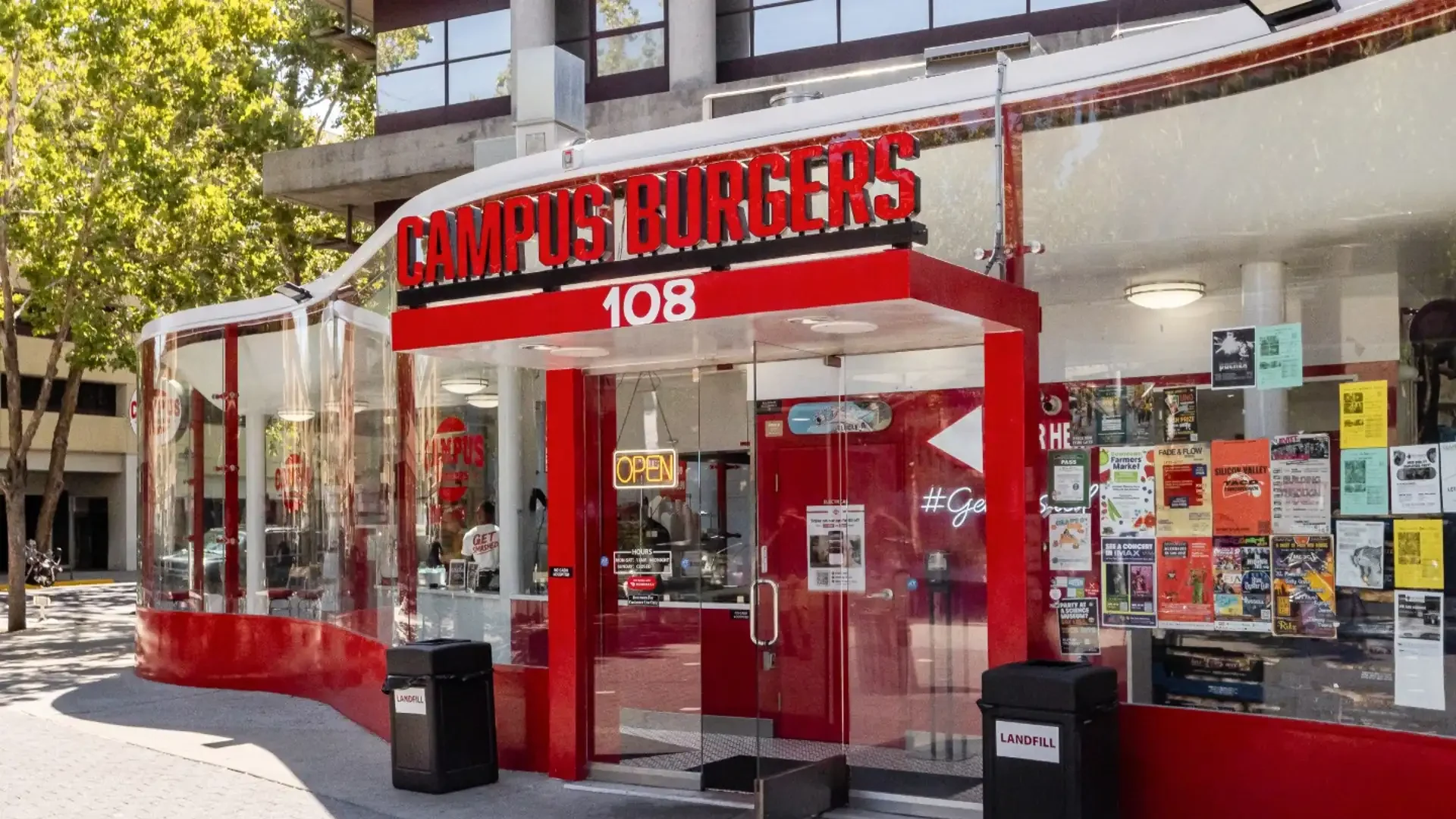
Campus Burgers, a Northern California smash-burger chain with four operating stores and as many as seven more in franchise development, has picked 4204 Rolando Boulevard as one of two San Diego franchise sites announced this summer. The Rolando store moves into the former Garden Kitchen space and targets an opening between September 2026 and January 2027, pending permits and construction. A separate franchisee, Greg Nazloo, is standing up a Campus Burgers at 978 Garnet Avenue in Pacific Beach with a Labor Day Weekend 2026 target. For a five-unit brand, having two independent operators debut in the same city inside a four-month window is an unusual pattern, and the site choices tell you what the concept is really testing.
The College Submarket Playbook
Every store Campus Burgers has opened sits inside walking distance of a university. The first store went into downtown San Jose in 2024 near San Jose State. The chain added a Park Avenue location in San Jose, a Berkeley store on Channing Way that opened September 15, 2025, and a Gilroy site on 1st Street. The named pipeline extends the same site pattern, with Davis at 720 2nd Street targeting a September 2026 opening timed to the UC Davis fall quarter, and Santa Cruz and Mesa, Arizona, rounding out the confirmed sites in the seven-store franchise queue.
Rolando fits that thesis, sitting directly south of San Diego State University’s main campus and inside the daily trade area SDSU’s off-campus student population uses for casual food. Pacific Beach is a different bet on the same demographic, blending SDSU spillover, UCSD students who cross to the coast, and dense residential foot traffic.
The $1.99 Unit Price Forces the Site
The concept economics on the menu are what force the site selection into campus corridors. Campus Burgers’s menu prices are $1.99 for a hamburger, $2.99 for a cheeseburger, $3.99 for a double, and $4.99 for a double cheeseburger, with fries at $5.99 and sodas at $2.99. At those unit prices, the store makes its numbers on volume rather than ticket size, and a typical San Diego corridor rent underwritten to $12 to $15 average tickets does not work at this concept’s ticket profile. Co-founder Mark Angelopoulos said the same thing when the Berkeley store opened, that the business can “make the numbers work” through steady traffic and that “going out shouldn’t be a luxury”.
The Davis build gives you the physical shape of that math. The store is 900 square feet with self-service kiosks, phone ordering with text confirmations, and remote payment. A 900-square-foot QSR box with kiosk-first ordering is a labor and rent optimization on both sides, with fewer front-of-house staff, less square footage to pay for, and a customer flow designed to move a lot of $1.99 tickets through a narrow footprint. That shape only pencils out where foot traffic is dense and predictable, which is what a university corridor gives you and what a general commercial strip does not.
The Two-Franchisee SD Debut
For an operator watching a chain from the outside, two franchisees entering the same city within one summer is a data point worth reading carefully. It can mean the brand is being aggressive on territory sales because franchise fees are the growth engine. It can also mean the two neighborhoods, Rolando and Pacific Beach, are being treated as non-overlapping trade areas rather than competing units. Rolando and Pacific Beach sit in different submarkets serving different demand pools, so for a $1.99 unit price and student-primary demand, they function as two separate markets.
Nazloo framed the Pacific Beach launch as a citywide market bet when he said, “Our vision goes beyond opening a single restaurant. We want Campus Burgers to become the staple smash burger destination for all San Diegans, a place people immediately think of when they’re craving an incredible smash burger”. That is franchisee-owner language, which tells you the growth structure. The unit operators are the ones making the city-level bet, with the brand supplying the format.
The Rolando First-Six-Months Test
The Rolando store answers three specific questions in its first six months. First, whether Campus Burgers can hold $1.99 as a real price rather than a promotional peg once SoCal build costs and California labor land on the P&L, because every Campus Burgers marketing surface leans on that price. If the concept has to hide a markup somewhere, it loses its distinguishing lever. Second, whether the Rolando franchisee follows the Davis 900-square-foot kiosk-heavy template or builds bigger for family and takeout traffic, because the kiosk model is where the concept’s labor math lives. Third, how the Pacific Beach store performs in its first quarter, because that store opens four to six months before Rolando and will be the read-through for Rolando’s own underwriting.
For SoCal operators watching a brand enter their market, this is a two-store pattern to track. The second entry reads through to the first, and the pair together will tell you how a $1.99 smash-burger format translates from campus towns in NorCal to a metro college submarket in San Diego.
Sources
- WhatNow San Diego, “Campus Burgers Working on New San Diego Location” (2026-07-13)
- WhatNow San Diego, “Campus Burgers Making San Diego Debut in PB”
- WhatNow Sacramento, “Campus Burgers Is Bringing the $1.99 Smash Burger to UC Davis”
- Campus Burgers, “Home / Menu”
- The Daily Californian, “Campus Burgers opens on Channing Way, bringing $1.99 burgers to Berkeley”
Businesses Mentioned
Tags