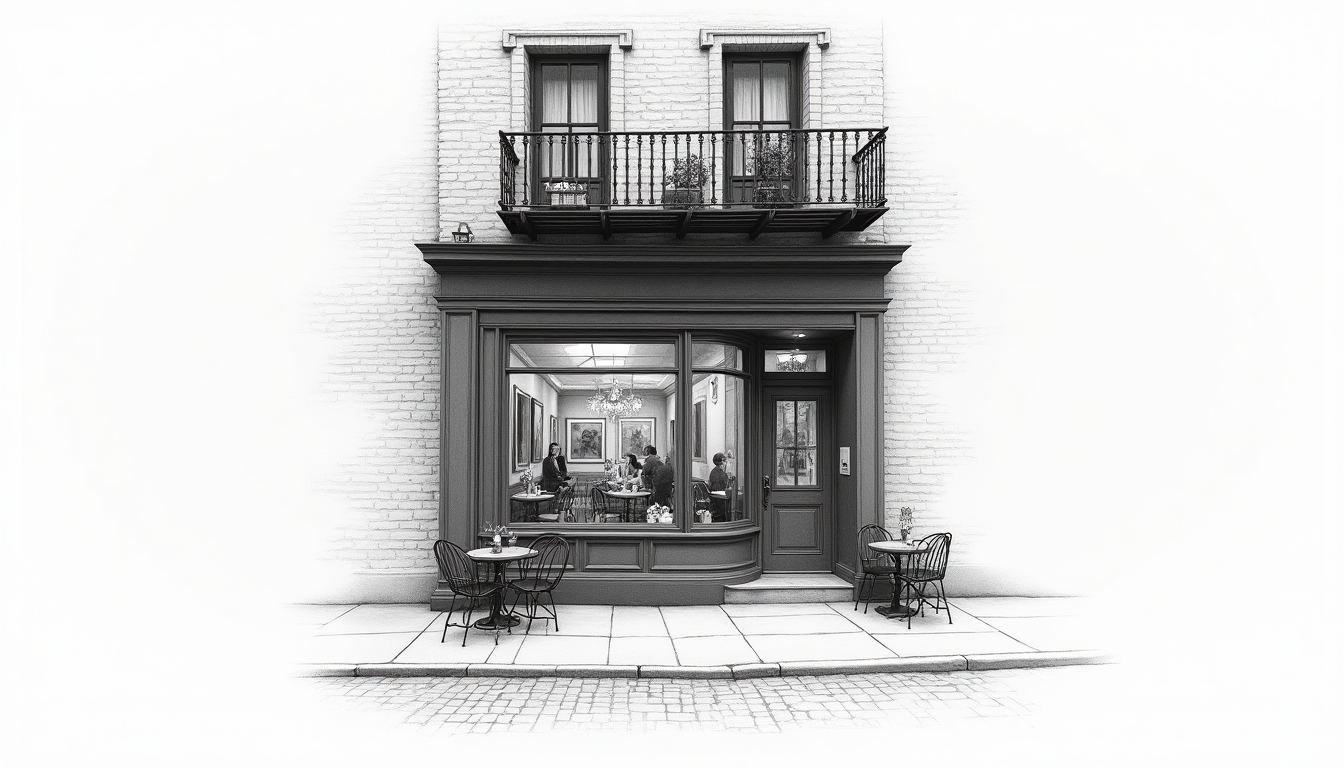
What Now NYC and Hoodline both reported this week that Gabriele Tosi and Mattia Casarin, formerly executive chef and head chef at Fiaschetteria Pistoia, are opening Prosciutto, a roughly 20-seat Italian restaurant with a maximum occupancy of about 45 at 435 E 9th Street in the East Village, in a ground-floor space that was formerly a psychic shop. The pending license is for beer, wine, and cider rather than full liquor, and live acoustic jazz and occasional karaoke are planned. On its face, it’s one new restaurant, but the format choices read as something larger.
What the Format Actually Says
When two senior operators leave an established West Village concept to run their own room, the room tells you what they think they can build economics on right now. Twenty table seats with 45 maximum occupancy is a specific bet. It says payroll will run on a small line, the kitchen will be tight enough that one of the two principals can be on it every night, the beverage program has to clear margins on beer/wine/cider rather than on a full bar, and the customer relationship has to do most of the marketing work. There is no slack for a 60-cover brunch or a tasting-menu Saturday at this footprint. This is a different operating thesis from Fiaschetteria Pistoia, the West Village trattoria at 114 Christopher Street where Tosi and Casarin built their resumes. The model is chef-on-the-line, beverage-license-light, room-small-enough-to-fill-on-regulars.
The NYC Cost Backdrop
The format choice maps onto a cost line that’s been compressing the standard NYC full-service model for two cycles running. The state’s NYC minimum wage stepped up to $17.00 an hour on January 1, 2026, with the tipped-cash floor at $11.35. The National Restaurant Association’s 2026 State of the Restaurant Industry report found 42% of operators reported their restaurants were not profitable in 2025, with 60% reporting softer customer traffic. Food, labor, insurance, energy, and swipe fees were named as the persistent stressors.
For a 60-to-100-seat NYC full-service Italian, those numbers compound through every line. For a 20-seat operator with a beer/wine/cider license, several of them shift posture. A New York Restaurant Wine License runs roughly $960 for a two-year term, and beer-and-wine licenses are generally less expensive than full on-premises liquor licenses. The carry on that license category is materially lighter on insurance and compliance, the bar takes less floor, the back-of-house can run smaller, and the break-even cover count drops. That’s the economic content of the format choice, and the senior-chef tier in NYC is testing 20-seat boxes right now rather than expanding established mid-size rooms.
The Corroborating Cohort
Prosciutto isn’t the first room of its kind in this stretch. Bar Miller, the 8-seat omakase counter from chef Jeff Miller in the East Village, opened in September 2023 and earned a Michelin star. Lavagna, the East Village trattoria at 545 E 5th Street, opened February 1, 1999, and runs a 16-seat seasonal sidewalk café alongside its dining room, the long-format precedent for the same neighborhood thesis. Both rooms run on the same operating logic Prosciutto’s principals are betting on, and the senior-chef tier choosing this format now is the new piece.
What This Means for NYC Operators
We track these patterns across Corbett’s four markets (California coastal, Boston/New England, New York City, and Miami), and the NYC small-format shift is the most concrete competitive signal for established mid-size full-service operators in this cycle. The customer paying $80 to $150 a head in the East Village or West Village is increasingly willing to do that inside 20 seats. The senior chef who would have managed your second concept five years ago is more likely to be opening their own 20-seater today.
Two practical implications follow for owner-operators reading the current cycle. First, the strategic value of an established NYC full-service Italian or chef-driven concept is highest right now to a multi-unit group or a strategic buyer who can amortize design, beverage, and back-office across multiple rooms. The single-location operator absorbing the full cost stack alone is the harder asset to clear.
Second, Q1 2026 brought F&B M&A activity to a near five-year high nationally, and acquirer appetite is shifting toward profitable middle-market operators. The exit window for a strong NYC independent is open. The question is whether the operator wants to run that conversation on a structured basis, or wait for the cost line to compress further into the trailing twelve months. We’re here when you’re ready to talk through what your situation looks like in this cycle, no pressure, no timeline.
Sources
- What Now NYC, “Cozy Italian Restaurant Coming to the East Village Location”
- Hoodline, “Psychic Shop Out, Pasta In, Prosciutto Plots Cozy East Village Takeover” (May 2026)
- Yelp, “Fiaschetteria Pistoia (West Village)”
- Michelin Guide, “Bar Miller New York”
- Lavagna, “Our Story”
- New York Department of Labor, “Minimum Wage”
- National Restaurant Association, “2026 State of the Restaurant Industry”
- The James Firm, “How to Get a Beer and Wine License in NYC and Nassau County” (March 2026)
- Capstone Partners, “Restaurant Market M&A Update”
Businesses Mentioned
Tags