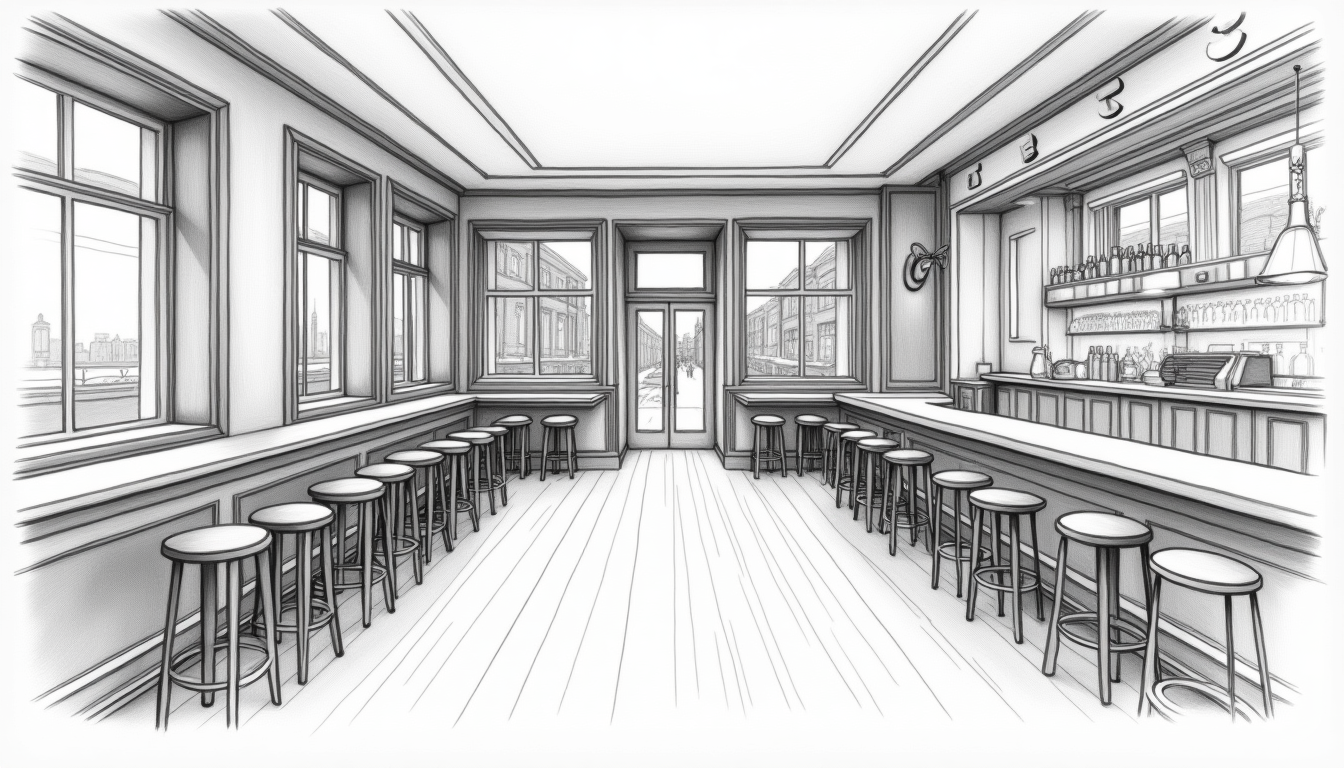
Scholars American Bistro and Cocktail Lounge, the 15-year nightlife-anchored room at 25 School Street in Boston’s Downtown Crossing, is closing permanently after this weekend, per the operator’s website and a poster within the Friends of Boston’s Hidden Restaurants Facebook group. Scholars first opened in 2011 with regional American dishes, beer, wine, and cocktails, semi-private spaces, karaoke, and DJs. The 300-seat room is run by the same operator group behind Emmet’s Irish Pub and 6B Lounge Martini Bar on Beacon Street, plus Crossroads Irish Pub in the Back Bay.
A 15-year nightlife institution exiting Downtown Crossing is a single closure on its face. The corridor it is exiting, and the operator portfolio choosing to walk away from this room while keeping the others running, is the read for Boston multi-corridor operators this cycle.
What the closure is sitting on
When the operators behind Emmet’s, 6B Lounge, and Crossroads keep three rooms running on Beacon Street and in the Back Bay, and choose to exit the School Street outpost in Downtown Crossing after 15 years, the signal is corridor-specific. Beacon Hill and Back Bay are residential, while Downtown Crossing is office-dependent and tourist-supplemented, and its nightlife daypart is structurally tied to post-work office foot traffic. The Downtown Boston Alliance service area, which includes Downtown Crossing and much of the Financial District, posted year-end 2025 office vacancy at 25.2%, down 3.3 percentage points from the pandemic-era peak of 28.5%, a sixth consecutive quarter of decline. The corridor is improving on the office side, but is not back to pre-pandemic baseline.
Stephen V. Miller, owner of Clarke’s at Faneuil Hall, told the Boston Globe in April 2026 on his own 50-year operation’s closure that “the downtown area is still not back to where it was pre-pandemic, and I just don’t think it’s going to happen for a while.” Clarke’s closed in April after the property foreclosed in June 2025 and Miller’s group lost the auction on the underlying real estate. Boston Chops closed both its Downtown Crossing and South End rooms at the start of January 2026, which makes Scholars the third significant Downtown Boston full-service closure inside roughly five months. Three institutional Downtown Boston full-service rooms exiting against a 25.2% office vacancy that has improved but not normalized is a corridor story rather than an operator-specific one.
The Broader Cost Stack Behind the Closures
The Downtown Boston regulatory and demographic stack is the local cut, with the national cost stack sitting underneath as the second layer. The National Restaurant Association’s 2026 State of the Industry release reported that 42% of operators said their restaurant was not profitable last year, 60% reported softer customer traffic, and more than nine in ten flagged food, labor, insurance, energy, and swipe fees as significant challenges. The number of independent restaurants in the United States declined 2.3% in 2025, a net loss of about 9,500 locations, with full-service independents posting a 2.6% decline and a net loss of about 6,400 rooms.
A 15-year nightlife-anchored full-service room on an office-dependent corridor, signed against 2011 unit economics and a 300-seat capacity, is sitting at the intersection of every line on that list. Wage, insurance, and food cost lines are elevated against 2026 conditions while the post-work nightlife daypart that supported the original deal economics has compressed against a Downtown foot-traffic baseline that is still working its way back.
The Boston Operator Read
The multi-corridor operator portfolio choosing to keep Beacon Street and Back Bay rooms running while closing the Downtown Crossing outpost is making a corridor bet, and the corridor bet is consistent with the Boston deal pattern winning this cycle. Residential corridors with built-in walk-up dayparts (Davis Square, Beacon Hill, Back Bay, the South End, Savin Hill) are absorbing the cost stack better than office-dependent corridors waiting on a return-to-office baseline that is improving but is not back. The same read applies across the New York, Miami, and California coastal markets we cover.
The strategic value of a residential-corridor F&B concept with a clean P&L is highest right now to a multi-corridor operator who can fold it into an existing portfolio. The single-location operator on an office-dependent corridor, on a lease structure cut against pre-2020 foot traffic, is the harder asset to clear, and the cost line is more likely to compress further than ease until the office baseline rebuilds. If this sounds like your situation, we’re here when you’re ready, no pressure, no timeline.
Sources
- Boston Restaurant Talk, “Scholars American Bistro and Cocktail Lounge in Boston’s Downtown Crossing Is Closing” (2026-05-13)
- Boston Restaurant Talk, “Scholars American Bistro and Lounge Opening Near Boston’s Downtown Crossing” (2011-02)
- Boston Real Estate Times, “Downtown Boston Records Fastest Office Market Recovery in Region; Vacancy Falls for Sixth Straight Quarter”
- The Boston Globe, “After 50 years, Clarke’s at Faneuil Hall closing, an owner says” (2026-04-17)
- PR Newswire / National Restaurant Association, “Persistent Cost Increases and Enduring Demand Will Shape the Restaurant Industry in 2026” (2026-02-12)
- Restaurant Business Online, “The number of independent restaurants declined by 2.3% in 2025” (2026-04-29)
- Boston.com, “Boston Chops closes both locations ‘to make way for new ownership’” (2026-01-02)
Businesses Mentioned
Tags