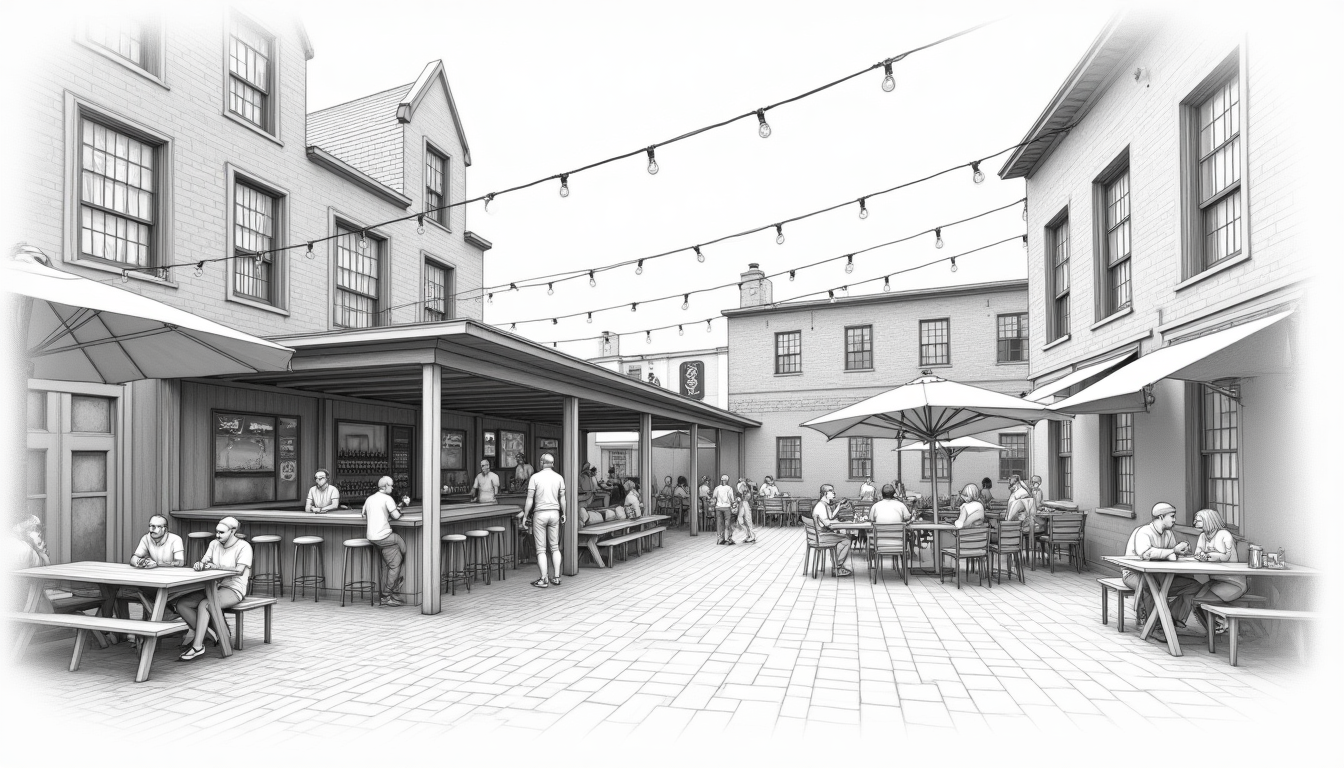
Tree House Brewing’s outdoor beer garden is now open at Faneuil Hall Marketplace, in the space that used to hold the Cheers Replica Bar and Mija Cantina & Tequila Bar. The indoor brewery and distillery, roughly 9,700 square feet across ground floor and basement, is still under construction. The Farmer-Brewery license application is still working its way through the Massachusetts Alcoholic Beverages Control Commission. So the operator question is what this transition tells anyone running an F&B business in Boston or New England right now.
Tenant Mix Is Rotating at the Marketplace
The Cheers Replica Bar in that space closed in 2020 during the pandemic. Mija Cantina had been in the marketplace since 2011. The replacement is a regional Massachusetts craft brewery. The basement holds a one-barrel brewing system, a two-barrel brite tank, and a distilled spirits production area.
For operators, the signal here is about what landlords at iconic locations are saying yes to in 2026. The mix is rotating toward local-credibility brands that can pull both tourist and resident traffic. If your concept reads as the seventh chain-clone in a marketplace setting, the comps just got harder.
The Phased Open Is the Story
Tree House filed its license application on March 30, 2026. The outdoor beer garden was open by late May, roughly 60 days later, while indoor construction continues. That is a deliberate operating choice I see more often in the deals I work in Boston, where buyers run a couple of plays.
First, it generates revenue and brand presence at the new address before the heavy capital is on the floor. Cans to go, outside food allowed in, a bar and patio, all low-CapEx, high-visibility presence. Second, it lets the brand season the team and the traffic patterns before committing to the full operating model. Third, it spreads regulatory risk across two timelines, since the outdoor garden operates on a narrower permit footprint while the city pouring permits and the full distillery licensing work through the Boston Licensing Board and the ABCC.
If you are a Boston operator looking at a sale in the next 12 to 24 months, this changes what buyers want to see in your buildout. Buyers who can phase a take-over value flexibility in the lease and the operating documents. Specifically, they want divisible square footage, separately permitted patio or sidewalk components, and a landlord relationship that tolerates phasing. We see deals close at stronger multiples when those flexibilities are baked in, because the buyer can model a slower ramp without taking the full hit on day one.
Tree House’s Boston Arc
This is not Tree House’s first attempt at a Boston footprint. In 2024 the company explored a Prudential Center taproom, distillery, and tasting room that did not move forward. What stayed in place at the Pru is a pickup shop offering in-store and curbside pickup alongside a seasonal beer garden. Two years later, Faneuil Hall is the larger Boston commitment, with a bigger footprint and a fuller license package.
Multi-year market entry like that tells you how a regional brand with capital thinks about a new metro. They test with a small footprint first, live with that smaller presence for a couple of years to learn the city’s licensing rhythm and daypart patterns, and only then commit to the full concept. For operators thinking about being acquired, the buyer’s pacing tells you what kind of offer to expect. Fast-moving buyers usually pay a discount or assume higher risk, while patient buyers pay full freight and do more diligence. Know which one you are sitting across from before you set expectations on price.
Boston Licensing Slows Out-of-Market Buyers
Tree House applied at the end of March, opened the patio by late May, and is still waiting on full city pouring permits and ABCC approval as of this writing, which counts as a fast track by Boston standards. For operators selling to an out-of-market buyer, set expectations on this timeline early in the LOI. Buyers from California or New York routinely underestimate how long Boston licensing transitions take. A realistic timeline in the purchase agreement is what protects the deal closer.
The Indoor Open Is the Real Test
The indoor opening will measure how confident Tree House is in the full-program traffic at this location, beyond the seasonal patio. The other marker worth watching is what fills the next set of Faneuil Hall rotations. If the rotation trend holds on the tenant mix, the marketplace becomes a more interesting comp set for regional craft and local-brand operators across the New England market, and a harder sell for chain-affiliated concepts.
For Boston and New England F&B operators evaluating a sale, the phased-open template is becoming standard for well-capitalized buyers. Make sure your lease, your buildout, and your operating documents support phasing, because that is where the multiple lives now.
Sources
- Boston Restaurant Talk, “Tree House Brewing Opens Outdoor Beer Garden at Faneuil Hall in Boston” (2026-05-25)
- Boston.com, “Tree House Brewing eyeing Faneuil Hall as next brewery location” (2026-04-23)
- What Now Boston, “Tree House Brewing Could Be Expanding to Boston’s Faneuil Hall Marketplace”
- Boston 25 News, “Tree House Brewing looking to expand into space that once housed iconic Boston bar”
- Boston Restaurant Talk, “Tree House Brewing Is Looking to Open at Faneuil Hall Marketplace in Boston”
Businesses Mentioned
Tags