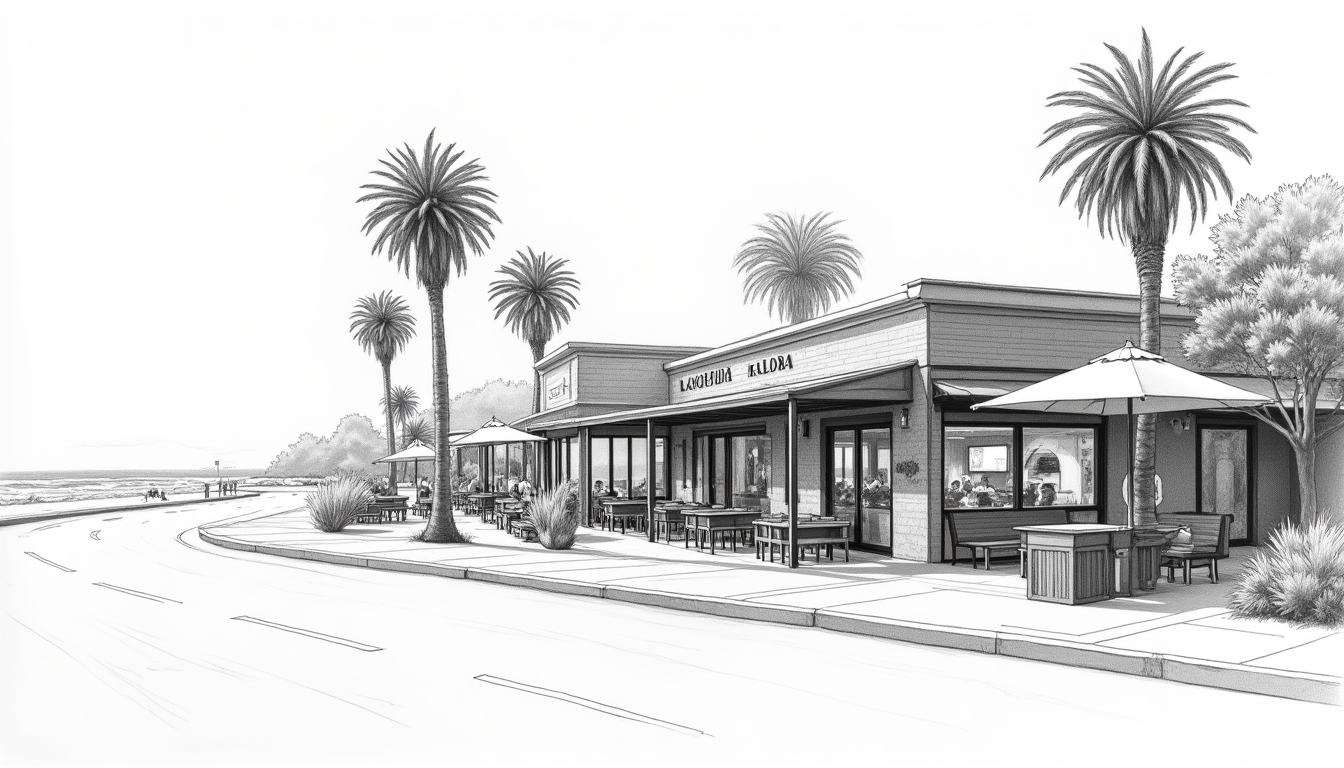
Truly Pizza opens its second location at 320 North Coast Highway in Laguna Beach on May 7, three years after co-founders John Arena and Donna Baldwin launched their flagship in Dana Point. The Laguna unit sits next to Urth Caffe on the main PCH stretch through downtown, anchoring the brand’s move up the coast. A third location in Venice Beach is targeted for late 2026.
Arena is a Las Vegas pizza veteran who moved west in 1980 with his cousin and built his career around a family pizzeria tradition that traces back to New York. Founding pizzaiolo Chris Decker took home the Best Pizza Chef Award #42, and pizzaiolo Michael Vakneen rounds out the kitchen. The signature product is a 12-inch hearth-baked round and a square format built on a three-day fermented dough that delivers what the team calls micro-blistering, the small char points that form across the crust when the slow-developed bubbles meet high heat.
A Three-Unit Coastal Strategy
What Truly Pizza is building is the kind of tight geographic concept that should be familiar to any operator who has watched a single-location independent try to scale into a small group. The strategic discipline behind the model is the part worth reading. Three units, all on the California coast, all in walkable beach communities, with no inland or freeway-anchored stops in the pipeline.
Donna Baldwin framed the positioning directly when she told Laguna Beach Indy that “beach communities have an energy you just can’t replicate” and that the brand expands where its operating values align rather than where the next available site happens to sit, which is the operational principle behind the entire three-unit strategy. Dana Point, Laguna Beach, and Venice Beach occupy similar audience, daypart, and customer-baseline profiles, which makes the second and third units operationally similar to the first.
For pizza specifically, this matters more than it does in other formats. Pizza is a low-ticket, high-volume business where unit-level economics depend heavily on consistent traffic patterns, repeat frequency, and the percentage of off-premise sales that flow through the same kitchen. A second unit in a similar market gives the kitchen team a near-identical playbook. A third unit in a third similar market does the same. That replicability is what makes a 2-to-3 unit group operate closer to a single-location than a multi-format restaurant company.
The Replicable-Group Buyer
Brokerage-side, this is the operator profile that becomes a strategic buyer for single-location concepts in the same lane. A 3-unit beach-community pizza operator becomes the natural acquirer for a strong single-location pizza concept in a fourth coastal market that fits the template, even though the same operator would be the wrong buyer for a 9-unit chain in a different category. The same logic applies in reverse for any operator on the California coast running a tight concept that another small group could absorb without retrofitting their playbook.
That dynamic is part of why we tell single-location sellers along the coast to think about who their buyer actually is before they price the deal. A 2-to-3 unit operator who has been disciplined about market selection is a different buyer than a first-time owner. They are paying for a template that fits their existing operation, which means brand strength, lease tenure, and operational documentation matter more in the sale package than they would for a buyer stepping into the business on day one.
The Laguna Coast Highway Address
The 320 North Coast Highway location is a high-foot-traffic block in downtown Laguna. The neighborhood mix is a downtown commercial district with strong tourist seasonality from spring through fall and a stable year-round resident base that supports off-season covers. The Urth Caffe next door is a useful directional indicator. Urth has been operating Laguna for years and has built its own cross-market footprint on similar real estate logic, which is to say the corridor supports premium-positioned, brand-driven food and beverage concepts at the rents PCH commands.
For Laguna and PCH operators broadly, the read is straightforward. Brand-driven concepts with disciplined operating models are still finding viable second and third locations on the most expensive coastal corridor in Orange County. The PCH lease market remains open to operators with strong unit economics and closed to operators trying to make weak unit economics work at coastal rents, which is the difference that has always defined that real estate.
The Coastal California Read
The pattern across coastal California in early 2026 is consistent. Operators with strong single-location performance are scaling into 2 and 3 unit groups by staying close to home and replicating into similar markets rather than chasing geographic diversification. Truly Pizza’s three-unit beach-community strategy fits cleanly into that pattern. The Melt’s expansion across Southern California, Daniel Patterson’s small-format Melrose return, and Carlos Altamirano’s ninth Bay Area opening all share the same operator-side bet on home-market depth over geographic spread.
Coastal owner-operators are facing a buyer pool that is concentrating around local multi-unit groups with replicable templates. Pricing your business on the assumption that a multi-state chain is going to roll in and pay strategic value is a slower process than pricing for a local small group that can integrate quickly. Both buyers exist, and the right answer depends on the concept, but the local-group path is the one closing deals on the California coast right now.
Corbett tracks these patterns across the markets we cover, including California coastal, Boston and New England, New York City, and Miami. We are here when you’re ready to think through what your situation looks like in this cycle, no pressure and no timeline.
Sources
Laguna Beach Independent, Truly Pizza Heads Up the Coast With Laguna Beach Location
OC Foodies, Truly Pizza Expands to Laguna Beach With Second Location
Businesses Mentioned
Tags